The deep read
What will it cost when it works?
The pilot budget is known. The cost of success, at full volume, month after month, is the number nobody has. The four disciplines and five questions that keep an AI program's economics owned.
Read the deep readElsewhere · five worth your time
The Token Trap: How AI Costs Spiral Past Your Budget
GAI Insights · 8 June 2026 · 5 min read
AT&T's internal AI now consumes 27 billion tokens a day, up from 1 billion eighteen months ago. A healthcare insurer went from 3 million tokens a month to 150 million in under a year. The authors' sharpest line: dashboards give you visibility, and visibility without optionality is just watching the bill arrive. Their structural fix is worth debating with your CIO: put at least one fixed-price provider in your AI supply base, so that every renewal stops being a negotiation where only one side can afford to walk away.
GitHub Repriced the Habit It Built
Artificial Confidence · 5 June 2026 · 6 min read
The clearest write-up of the June 1 change: Copilot moved to usage-based billing, the subscription price stayed put, and it now simply marks where the meter starts. Two buried details matter for any tool your teams already depend on. When credits run out, the tool stops rather than downgrading. And a code review now bills against credits and compute minutes at the same time. The pattern to remember: ship at a subsidized rate, train the workflow, then let the meter find its level. Your stack's renewal is somewhere in that sequence.
The Fable of the Gated Frontier
The Change Constant · 10 June 2026 · 3 min read
The model release everyone forwarded you this week, read through a business lens. Anthropic's new flagship ships at roughly twice the price of its predecessor, tops the public benchmarks, and moves onto metered credits after 22 June. The author's bigger point is the one to keep: the question is shifting from "how smart is the model?" to "which version of intelligence are you allowed to access, under what controls, at what price?" Capability now comes with three dials: who gets access, what they may do with it, and what it costs when they do.
The CHRO Will Be Blamed for the AI Layoffs
The CHRO Office · 5 min read
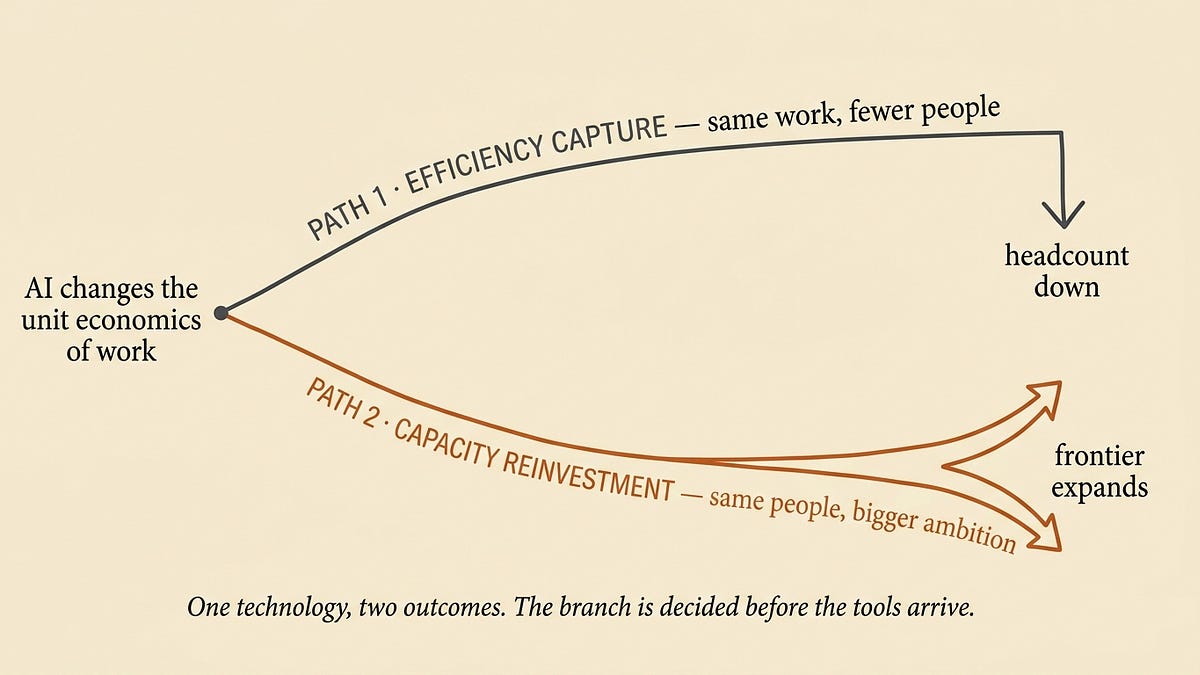
First-quarter tech layoffs reached roughly 78,000 roles, and companies attributed about half of them to AI. This essay argues the technology decided none of it. AI lowers the cost of a unit of cognitive work. What happens next depends on whether the organization treats work as a fixed box to shrink or a frontier to expand. Rigid structures default to cuts because cutting is the only move their budget process can execute. The bank-teller history alone is worth the click. If the people question is anywhere near your board agenda, start here.
Moatlessness
Sam Jacobs · 5 min read
A CEO-grade essay on what counts as defensible when anything can be copied in a quarter. Execution, he argues, is table stakes, and "staying one step ahead forever" is a treadmill, not a moat. A real moat is anything that makes catching you expensive. The executive job in the AI era is converting temporary advantages, product, distribution, speed, into structural separation before they decay. It pairs uncomfortably well with what cheap intelligence is doing to cost curves in every industry, including yours.