THE DEEP READ · ISSUE 01
What will it cost when it works?
Before a session with a hospitality group this spring, an insider walked us through why their leadership had stalled on AI. They did not doubt the technology. The blocker was a number nobody could give them. In his words: “Leaders don’t know how much an AI agent is going to cost them. If we don’t know what the cost is going to be to the company, we are not even going to give it a second consideration.”
We hear a version of that sentence in most rooms now. The board has approved the direction. The pilots are running. And the question that decides whether anything ships sits unasked at the end of the table: what will this cost us when it works? The pilot budget is known. The cost of success, at full volume, month after month, is the number nobody has.
June has made the question impossible to ignore. Three things happened in the last few weeks:
- Uber’s CTO said the company had burned through its entire 2026 AI coding budget by April.
- On 1 June, GitHub moved Copilot to usage-based billing. The subscription price stayed the same. It now marks where the meter starts, not what you pay.
- The newest frontier model launched at roughly twice the price of its predecessor, and its maker is moving subscribers onto metered credits within the month.
One shift underneath all three: the subsidy era of AI pricing is closing. For two years, vendors priced AI like software, a flat fee per seat, and quietly absorbed the difference to win the market. Now the meters are being installed. From here the bill follows the work the machine does, and seat counts tell you very little about it.
This matters because software never worked this way. A seat cost the same whether your team used it hard or barely logged in, so budgeting was arithmetic: count heads, multiply, done. An AI budget behaves like cloud compute or cost of goods. The bill is counted in tokens, the small chunks of text a model reads and writes, and it grows with every question asked, every document retrieved, and every step an agent takes on its own. When usage grows tenfold, the bill does too. Carrying the per-seat mindset into a metered world is the most expensive habit a leadership team can have right now.
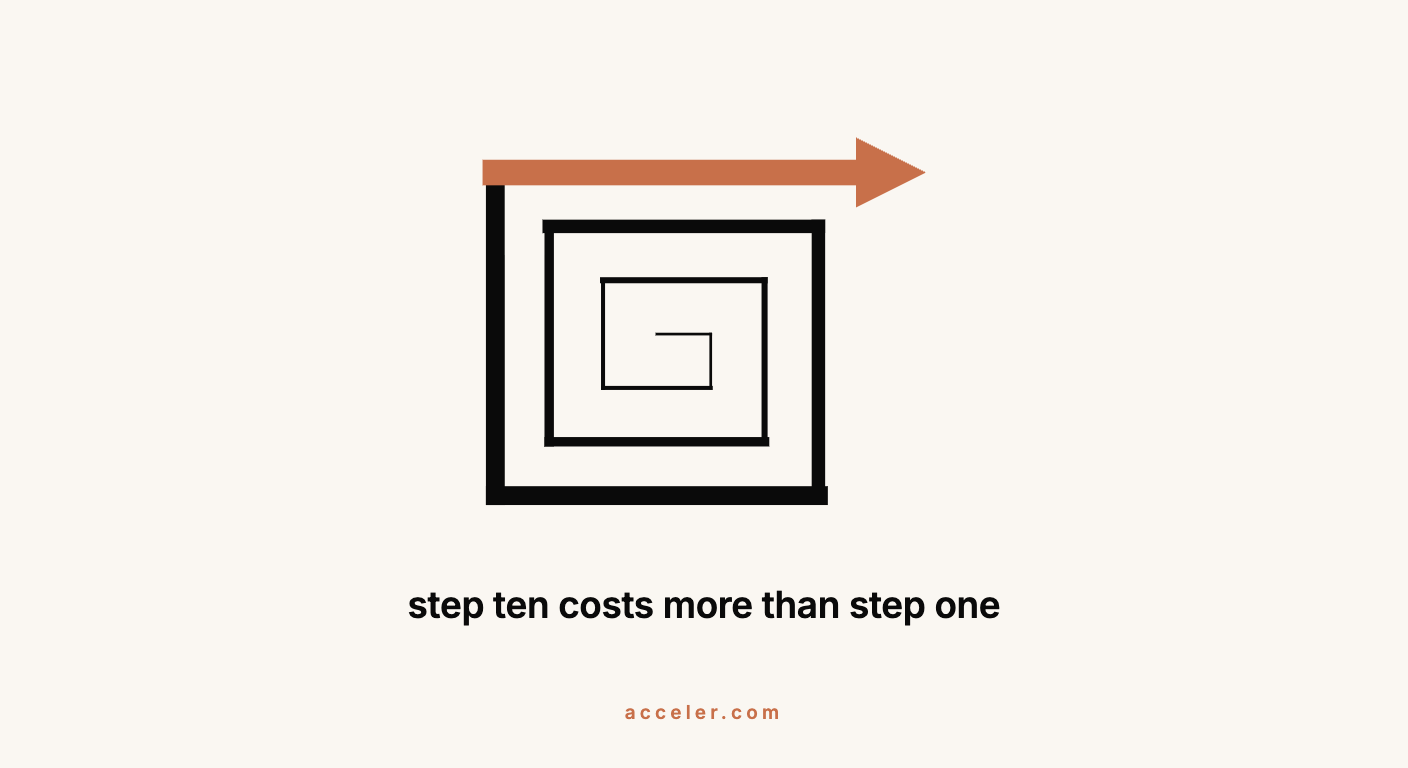
Agents make it sharper. A chatbot answer is one round trip: question in, answer out. An agent works in a loop: it takes a step, reads what came back, and decides the next step, around and around until the job is done. Two things compound inside that loop. The model produces reasoning you pay for but never see. And every step carries the full history of the steps before it, so step ten costs far more than step one. Gartner puts an agentic task at five to thirty times the tokens of a simple chat answer. Harder still for whoever owns the forecast: the same task can cost three times more on a bad day, because the agent wandered. You cannot budget an agent the way you budget a license, and most companies are still trying to.
Put all of this together and you get the trap we now warn every leadership team about. A business case promises ten million in call-centre savings. The program works, technically. Eighteen months later the model invoice runs fourteen million, and finance is looking at a project that cut ten and spends fourteen. Nobody chose that outcome. It assembled itself one engineer at a time, each defaulting to the most capable model for every call, with no cost budget set at design time and nobody owning the bill.
The milder versions are everywhere. A private equity operating partner described his portfolio companies as “setting money on fire”: AI licenses bought for everyone, used by almost no one, nothing tracked. An engineering leader with two hundred engineers told us his CEO now opens meetings with “We are investing in AI. How do we reduce cost?”, in the same quarter his team’s coding-assistant bill stopped being predictable.
The companies getting real returns run four disciplines. None of them needs a machine-learning specialist. They are closer to how you already manage cloud spend.
Give the bill one owner. Someone is named, and token spend is attributed per team and per workflow from day one. An unowned bill is how ten quiet engineering decisions become a seven-figure surprise.
Treat cost as an architecture decision. The same task can cost ten times less when someone designs for it. Route routine work to small, cheap models and reserve the frontier model for the calls that need it. Cache what repeats. Vendors charge about a tenth for input they have already seen. Run anything that can wait overnight as a batch job at half price. Cap how many steps an agent may take before a human looks. These levers are published and available today. Someone just has to be accountable for pulling them.
Budget the outcome, not the call. Decide what a resolved task is worth before anyone builds. One frontier lab’s internal heuristic is useful here: a ten-cent budget per task buys tens of thousands of tokens, enough for a scripted workflow and far too little for an agent that explores. If the work is routine, a fixed workflow beats an agent on cost and on consistency. Then measure the whole system, because the easiest way to fool yourself is to measure half of it. If AI resolves the simple tickets while your remaining people take three times longer on the hard ones left behind, your savings are zero. The only number a CFO should accept is cost per resolved outcome, fully loaded.
Push the meter back on vendors. Where you buy instead of build, ask for pricing tied to outcomes: a price per resolved case, or per processed claim. The most interesting vendors already sell this way, and it moves the volume risk to the people best placed to manage it. Where you cannot get outcome pricing, ask the renewal questions early and in writing, because the vendors are re-pricing around you this quarter either way.
None of this is a reason to slow down. Cost discipline is what makes speed safe, because a program with owned, predictable economics survives budget season and an unowned one does not. The leaders we watch compounding returns are rarely the ones spending the most. They are the ones who knew, before launch, what a result was worth and what they were willing to pay for it.
One thing to do this week: ask for the cost per resolved outcome of your most visible AI workflow, at today’s volume and at ten times. If the number arrives within a day, you are ahead of most. If it cannot be produced, you have found your real first AI project.
Notes & sources
- Uber’s 2026 AI coding budget exhausted by April: public remarks by Uber’s CTO, reported June 2026.
- GitHub Copilot moved to usage-based billing on 1 June 2026: GitHub’s published billing change.
- Frontier model pricing at roughly twice its predecessor, with subscription access moving to metered credits: Anthropic’s published Claude Fable 5 pricing, June 2026.
- Five to thirty times the tokens per agentic task versus a standard chat interaction: Gartner, March 2026.
- Caching at roughly one tenth of fresh input pricing and batch processing at half price: published rate cards of the major model providers, mid-2026.
- The ten-cent-per-task heuristic: Anthropic’s published guidance on building effective agents.
- Executive quotes are from Acceler leadership sessions and client conversations in the first half of 2026, anonymized.
Subscribe
The one email a senior leader reads to understand what AI is really doing inside companies like theirs. Written by people in the room, not analysts outside it.
Want to be in the room?
The quotes and stories in these articles come from closed-door sessions and dinners we host with leadership teams. If you want a seat at one of them, tell us who you are.